Coenzyme Q10: how to choose it and how to take it
Ubiquinone or ubiquinol, why fermentation is the preferred way of making it, what 100 mg means and why coenzyme Q10 is taken with food.
October 11, 2026
Coenzyme Q10 is found in every cell of the body and is one of the best-known names among food supplements. Products, however, differ — in form, origin and dose. Here is what to look for, and why.
How to choose
- A stated form. A good label says whether it contains ubiquinone or ubiquinol.
- Made by fermentation — this gives the natural form of the molecule.
- A clear dose in milligrams per daily dose.
- A certificate of analysis for the batch and packaging that protects from light.
- Taken with food — coenzyme Q10 is fat-soluble.
Why? Read on.
Ubiquinone or ubiquinol
Coenzyme Q10 exists in two main forms, which differ only in whether the molecule is oxidised or reduced. Ubiquinone is the oxidised form, ubiquinol the reduced one. In the body, coenzyme Q10 is converted from one form to the other.
Ubiquinone is the classic and more stable form — an orange, odourless and tasteless powder. Ubiquinol is more delicate: in air and light it quickly oxidises back to ubiquinone, so it needs special protection in the product (Temova Rakuša et al., 2021). Whichever form you choose, what matters is that the label names it.
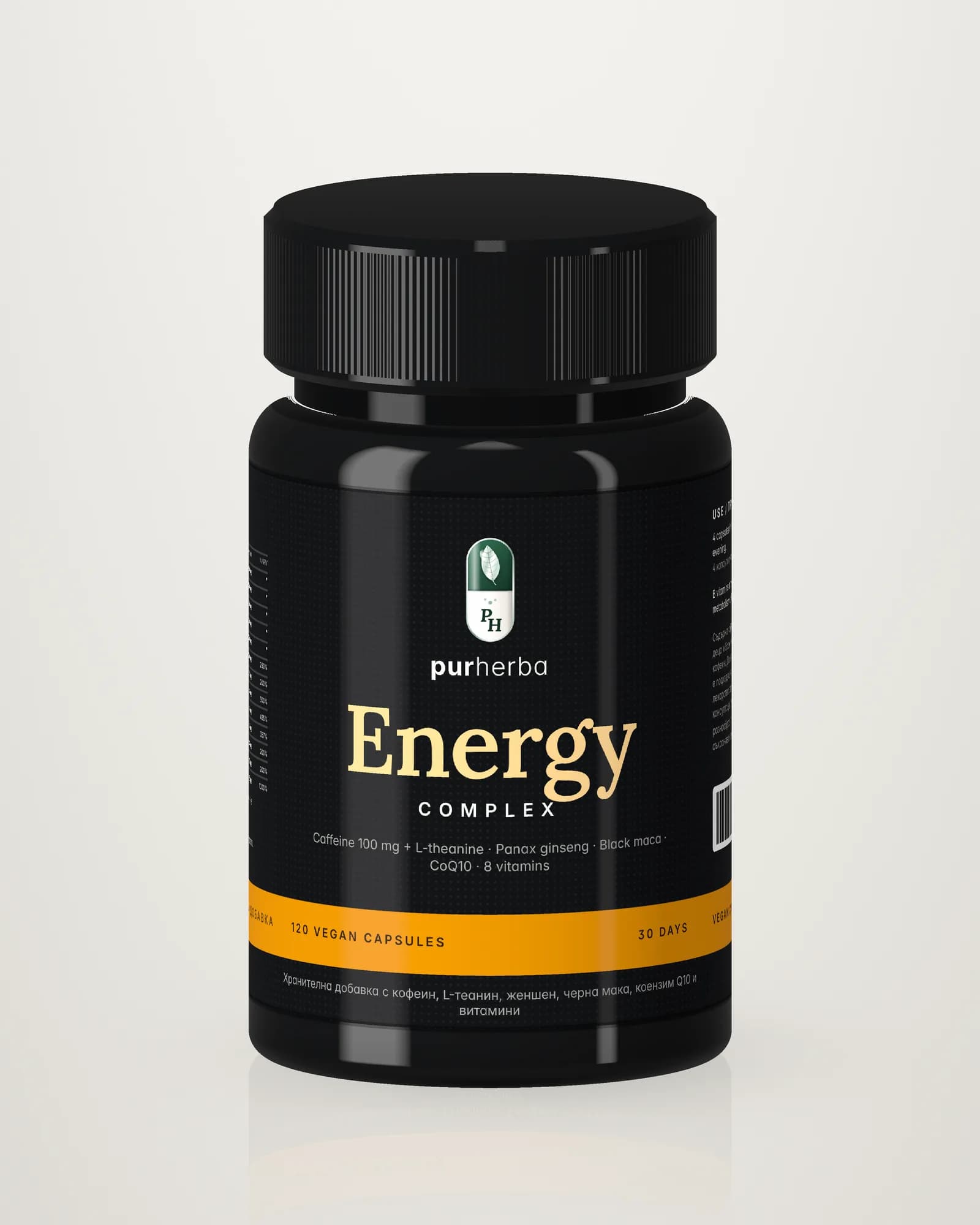
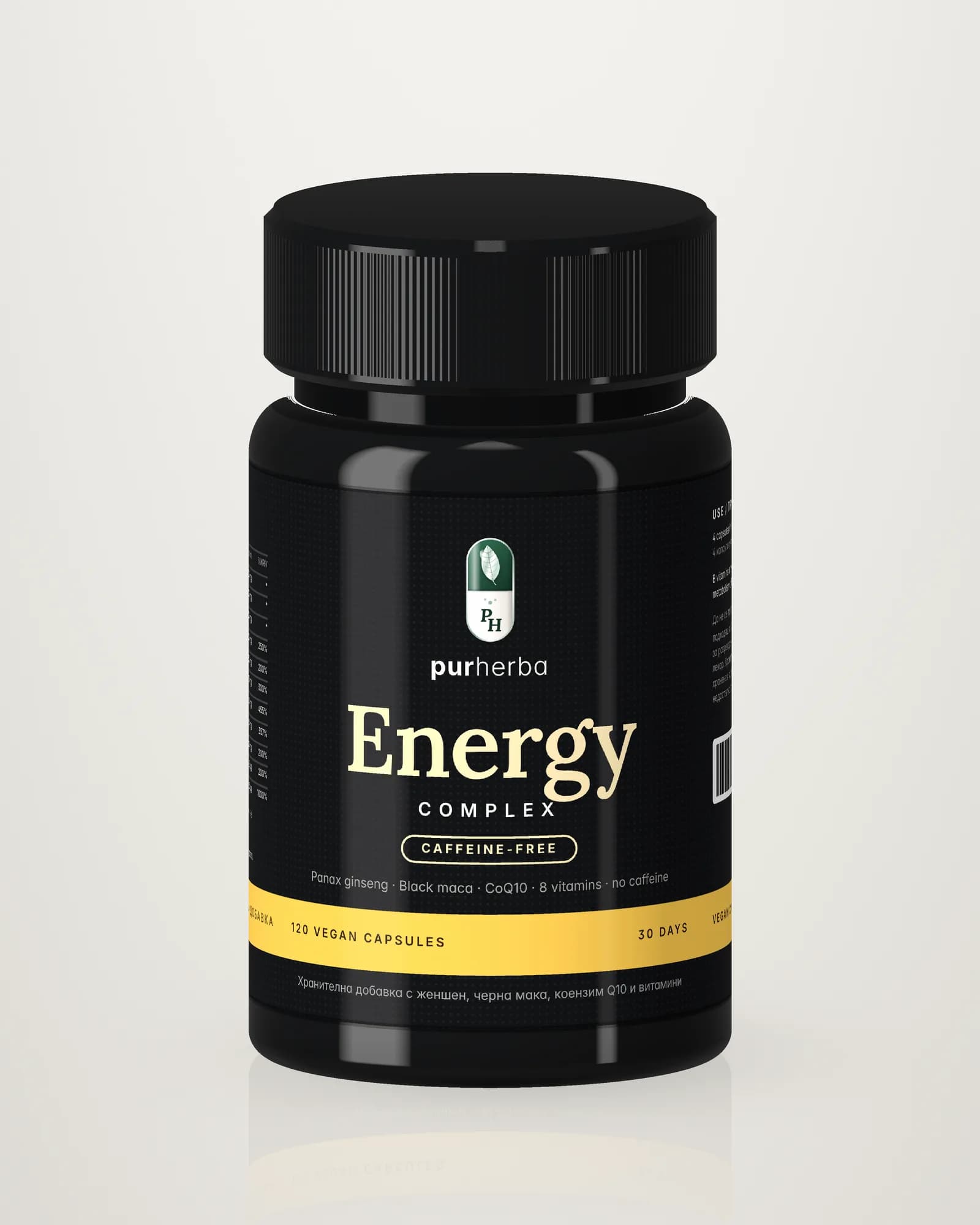
Found in:Energy ComplexEnergy Complex Caffeine-Free
Why fermentation
The coenzyme Q10 molecule is a quinone “ring” with a long tail of ten isoprene units — hence the number 10 in the name. In nature, this tail has just one spatial form — trans.
With chemical synthesis it is hard to obtain exactly this form without producing others as well. Microorganisms — yeasts and bacteria — build the molecule with the precision of their own enzymes, and this problem disappears. That is why fermentation is the preferred way of producing coenzyme Q10 (Lee et al., 2017).
What 100 mg means
Coenzyme Q10 is found in food — most in meat and fish, especially in the heart. The amounts, however, are small: beef heart contains about 113 µg per gram. One hundred milligrams of coenzyme Q10 corresponds to nearly 900 g of beef heart.
That is why, with supplements, a clearly stated dose in milligrams matters — it allows products to be compared fairly.
Why the certificate and the packaging matter
Coenzyme Q10 is sensitive to heat, light and oxygen. A good manufacturer protects it throughout the process — from the raw material to the packaging. Energy Complex comes in an opaque black pack that protects the contents from light. Store it in a dry, cool place.
The certificate of analysis confirms the coenzyme Q10 content, the heavy metals and the microbiology. The certificate for each of our batches is on the product page and behind the QR code on the packaging.
Where coenzyme Q10 comes from
In 1955, researchers isolated an unknown fat-soluble substance from the lining of horse intestine. The biochemist Morton later named it ubiquinone — “the quinone that is everywhere”, from the Latin ubique, “everywhere”.
In 1957, Frederick Crane of the University of Wisconsin isolated the same substance from the mitochondria of beef heart and called it coenzyme Q. Only a year later, its chemical structure was determined in Karl Folkers's laboratory. In 1978, Peter Mitchell was awarded the Nobel Prize in Chemistry for the chemiosmotic theory — one of the great discoveries in the biochemistry of the cell, in which coenzyme Q has a central place.
Coenzyme Q10 in Energy Complex
Both versions of Energy Complex contain 100 mg of coenzyme Q10 (ubiquinone) per daily dose, together with ginseng root extract (≥5% ginsenosides), black maca root extract (≥0.6% macamides), vitamin C and seven B vitamins in active forms. The caffeinated version also contains 100 mg of natural caffeine with 200 mg of L-theanine.
The claims authorised in the EU for the formula come from the vitamins in it: niacin and pantothenic acid contribute to normal energy-yielding metabolism, and folate contributes to the reduction of tiredness and fatigue.
How to take it
4 capsules in the morning with breakfast, with water. Coenzyme Q10 is fat-soluble and is absorbed slowly, so it is taken with food — best with a breakfast that also contains a little fat. The caffeinated version is not taken in the evening.
The products are not suitable for pregnant or breastfeeding women or for anyone under 18. If you take blood-thinning medicines or medicines for blood sugar, consult a doctor before use. The caffeinated version contains 100 mg of caffeine per daily dose, is not recommended for children and pregnant women and should not be combined with other caffeine-containing products, such as Metabolic Complex.
Sources
- 1.Boreková M, Hojerová J, Koprda V, Bauerová K (2008). Nourishing and health benefits of coenzyme Q10 – a review. Czech J Food Sci 26(4):229-241
- 2.Lee SQE, Tan TS, Kawamukai M, Chen ES (2017). Cellular factories for coenzyme Q10 production. Microb Cell Fact 16:39
- 3.Temova Rakuša Ž, Kristl A, Roškar R (2021). Stability of reduced and oxidized coenzyme Q10 in finished products. Antioxidants 10(3):360
- 4.The Nobel Prize in Chemistry 1978 — Peter Mitchell, facts. NobelPrize.org
- 5.Регламент (ЕС) № 432/2012 на Комисията за създаване на списък на разрешените здравни претенции (консолидиран текст, BG и EN)