Konjac glucomannan: how to choose it and how to take it
What konjac is, why the purity of glucomannan matters, why a 1 g dose is taken as a powder rather than in capsules, and why water is part of every serving.
October 11, 2026

Glucomannan is a soluble dietary fibre from the tuber of konjac, a plant that has been eaten in Japan and China for centuries. A good glucomannan product is easy to recognise once you know what to look for. Here is how, and why.
How to choose
- A stated purity. Look for glucomannan of at least 95%, not just "konjac powder".
- 1 g of glucomannan per serving: the amount at which the EU-authorised claim applies.
- Powder or sachets rather than capsules, so that one serving is one glass, not a handful of capsules.
- Clear instructions for water: how much to drink, and when, with each serving.
- A certificate of analysis for every batch.
Why? Read on.
Why purity matters
Konjac flour is simply the dried and ground tuber, and in it glucomannan is usually 70–90% of the dry matter. Purified glucomannan is made by washing the flour with aqueous ethanol, which rinses away the other components. The EU requirement for purified konjac glucomannan is at least 95% dietary fibre in the dry matter.
That is why "95%" on the label is an important number: it shows that a serving contains as much glucomannan as declared. The certificate of analysis for each of our batches is on the product page and behind the QR code on the pack.
Found in:Glucomannan 3000Glucomannan 3000 Powder
Why 1 g per serving
The authorised claim requires a food that contains 1 g of glucomannan per serving, taken three times a day. A good label states glucomannan in grams, not only the amount of konjac powder.
Found in:Glucomannan 3000Glucomannan 3000 Powder
Why a powder rather than capsules
1 g is more than one ordinary capsule holds, so each serving would take several capsules, three times a day. Powder stirred into a glass of water delivers the whole dose in one go, and the water comes with it.
Why water is part of every serving
Glucomannan absorbs up to about 200 times its own weight in water and forms a thick gel. That is why it is stirred into a large glass of water, drunk straight away and followed by more water, so that the fibre reaches the stomach. The instructions for water are not a formality; they are part of taking it correctly.
What glucomannan does
According to the health claims authorised in the EU (Regulation (EU) No 432/2012): in the context of an energy-restricted diet, glucomannan contributes to weight loss. The beneficial effect is obtained with a daily intake of 3 g of glucomannan in three doses of 1 g each, together with 1–2 glasses of water, before meals and in the context of an energy-restricted diet.
Konjac: the plant and the food
Konjac (Amorphophallus konjac) is a perennial plant of the arum family (Araceae), native to South-East Asia. It is the underground tuber that is eaten: it is harvested at around two years old, washed, cut into thin slices, dried and ground into flour. About half of the tuber is glucomannan.
In China, konjac is described as far back as the Shen Nong Ben Cao Jing, the classic work on medicinal plants from the Western Han dynasty, and it has been used for more than 2,000 years. In Japan, the flour is mixed with water and limewater to make konnyaku, a firm jelly that is cut into cubes. Shirataki, the translucent noodles whose name means "white waterfall", are also made from konnyaku and are about 97% water.
Chemically, glucomannan is a long chain of mannose and glucose units in a ratio of about 1.6:1, joined by β(1→4) bonds. Its molecules reach up to two million daltons, which is where its ability to hold so much water comes from.
Glucomannan in Glucomannan 3000
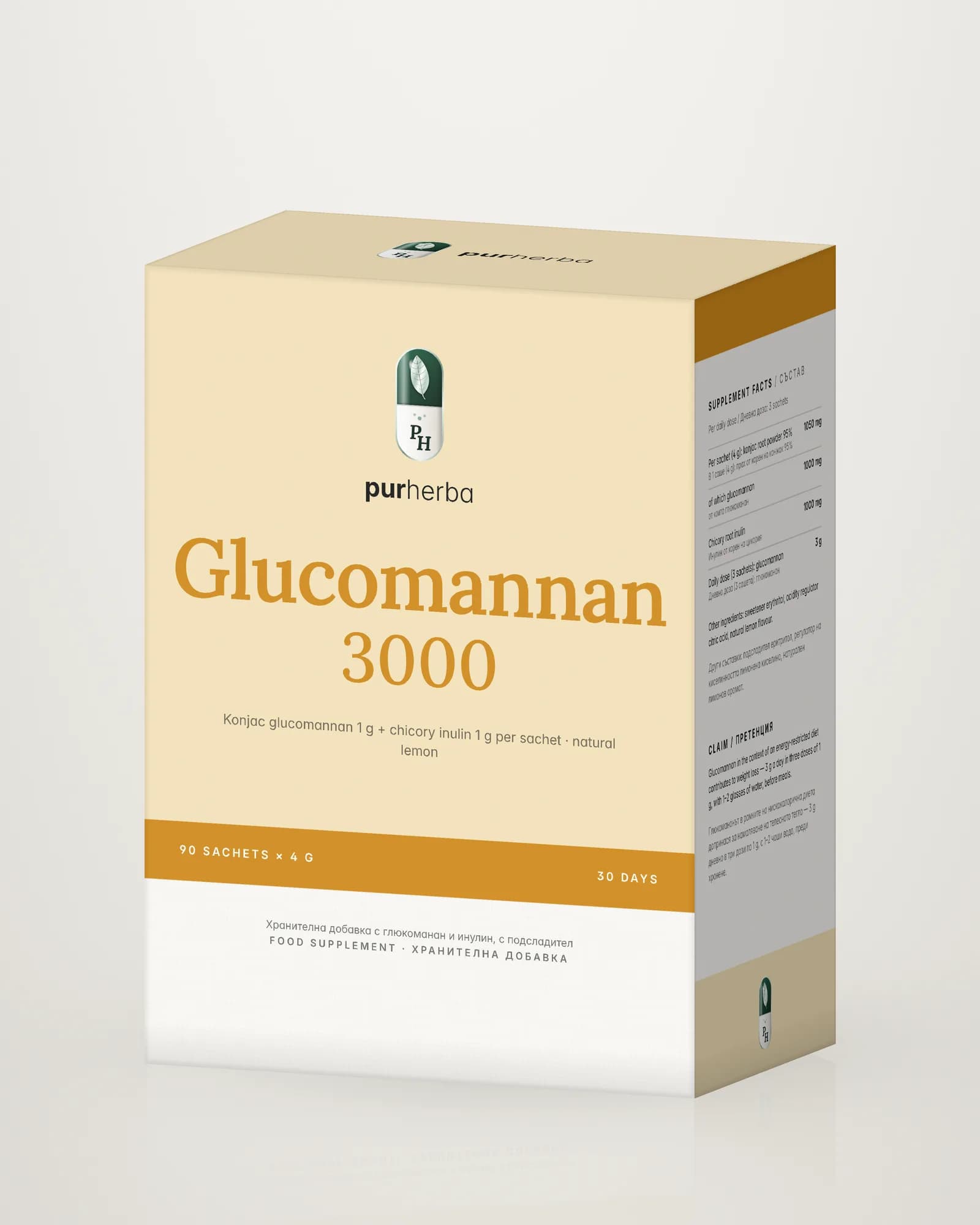
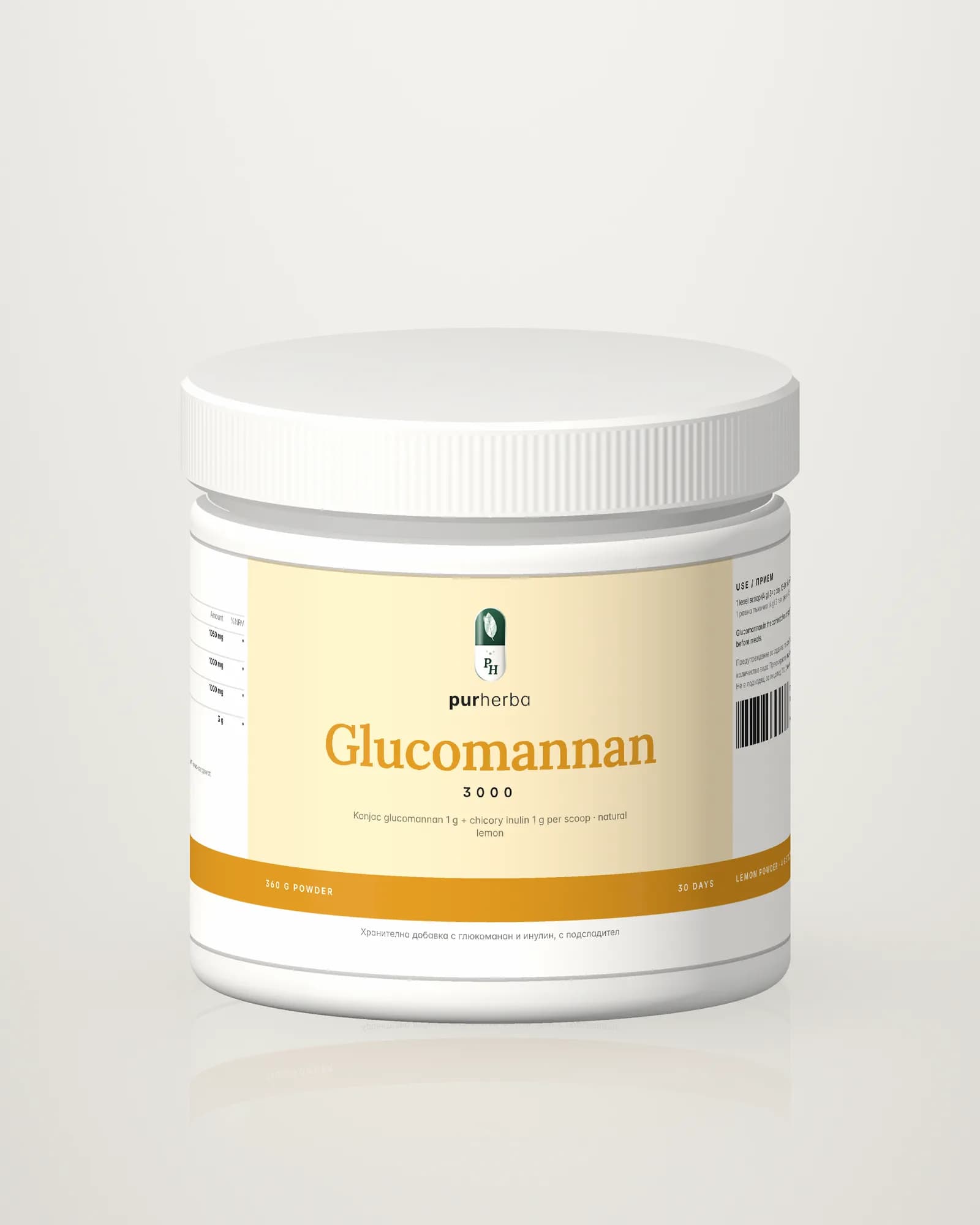
One 4 g serving contains 1,050 mg of konjac root powder, of which 1,000 mg is glucomannan (95%), and 1,000 mg of chicory root inulin, also a soluble dietary fibre, with a neutral, lightly sweet taste. The sweetener erythritol, citric acid and natural lemon flavour make the drink light and fresh. Three servings a day provide 3 g of glucomannan, exactly the amount in the authorised claim. Glucomannan 3000 comes in sachets and as a powder with a measuring scoop.
How to take it
- 1 sachet or 1 measuring scoop (4 g), stirred into 250 ml of water; drink it straight away, before it thickens, and follow it with another glass of water.
- 3 times a day, 15–30 minutes before the main meals, as part of an energy-restricted diet.
- Choking hazard: take with plenty of water so that the product reaches the stomach. Not suitable for people who have difficulty swallowing.
- Excessive consumption may have a laxative effect.
- Not suitable for people under 18, or for pregnant or breastfeeding women.
Sources
- 1.Регламент (ЕС) № 432/2012 на Комисията, консолидиран текст към 17.05.2021 — списък на разрешените здравни претенции
- 2.EFSA ANS Panel, Mortensen A et al. (2017). Re-evaluation of konjac gum (E 425 i) and konjac glucomannan (E 425 ii) as food additives. EFSA Journal 15(6):4864
- 3.Jain A, Sarsaiya S, Gong Q, Wu Q, Shi J (2025). Amorphophallus konjac: traditional uses, bioactive potential, and emerging health applications. Front Plant Sci 16:1530814
- 4.Wikipedia (EN). Shirataki noodles
- 5.Photo: “Morishita, Showa, Tone District, Gunma Prefecture 379-1204, Japan - panoramio (1).jpg”, kiwa dokokano, CC BY-SA 3.0, Wikimedia Commons