Glycine: how to choose it and how to take it
The smallest amino acid, named for its sweet taste: how to recognise pure glycine, why it comes as a powder and how to take it in the evening.
October 11, 2026

Glycine is the smallest and simplest amino acid, and one of the easiest to choose if you know what to look for. Here is how, and why.
How to choose
- Glycine only: no sweeteners, flavourings or fillers.
- Purity of 99% or more, confirmed by a certificate of analysis for the batch.
- Powder, not capsules: 3 g is easiest to take with a spoon.
- An accurate measuring scoop, so it is clear how many grams are in a dose.
- A pack that lasts: enough for months of regular use.
Why? Read on.
Why glycine only
Glycine is sweet in its own right, and its name comes from the Greek glykys, "sweet". It dissolves very easily in water (about 250 g per litre) and gives it a light, pleasant sweetness. That is why it needs neither sweeteners nor flavourings: a good product contains only glycine.
Glycine is also the only one of the common amino acids without mirror-image forms, so there is no "left" and "right" molecule. Any pure glycine is the same substance, so the difference between products lies in purity and dose.
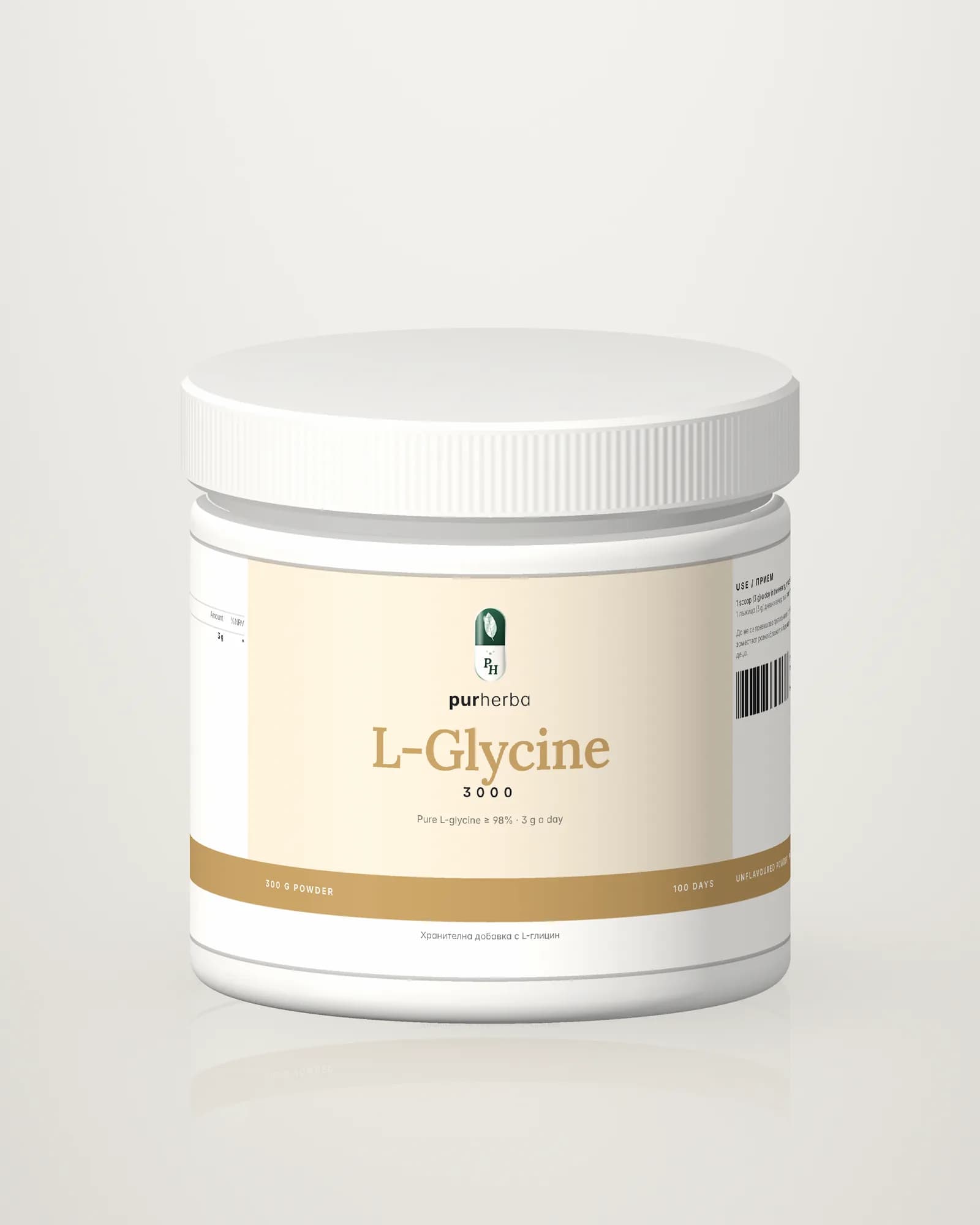
Found in:L-Glycine 3000
Why purity matters
Glycine for supplements is made by chemical synthesis, a route discovered as early as 1858, when the French chemist Auguste Cahours obtained glycine from monochloroacetic acid and ammonia. How pure the final powder is depends on the purification after synthesis.
So look for pharmaceutical- or food-grade glycine with a purity of 99% or more. A good certificate of analysis shows the glycine content, heavy metals and microbiology. The certificate for each of our batches is on the product page and behind the QR code on the pack.
Why a powder
3 g is a lot for capsules: one capsule holds less than a gram of powder, so a single dose would take several at once. As a powder, the same amount is one measuring scoop dissolved in a glass of water or tea: quick, with no sediment and no unnecessary shell.
Powder is also more economical: one product holds months of use, without the cost of hundreds of capsules.
Where glycine comes from
In 1820 the French chemist Henri Braconnot boiled gelatine with sulphuric acid and obtained sweet crystals, which he called "sugar of gelatine". The name "glycine" in use today was proposed by the Swede Berzelius in 1848, again because of the sweet taste.
It is no accident that it was discovered in gelatine. Collagen, the main protein in skin, bones and tendons, is built from a repeating triplet of amino acids in which every third one is glycine. Glycine is thus about one third of the amino acids in collagen: only such a small molecule fits into the centre of its triple helix (Bhattacharjee and Bansal, 2005).
The body also makes glycine, mainly from the amino acid serine, and we get it from food: meat, fish, dairy products, pulses and gelatine (Razak et al., 2017).
Our L-Glycine 3000
L-Glycine 3000 is pure glycine powder, with no sweeteners, flavourings or fillers. One measuring scoop contains 3 g of glycine, and one 300 g product lasts 100 days.
Glycine has a light, sweet taste and dissolves completely in water or tea, so it easily becomes part of an evening ritual.
How to take it
- 1 measuring scoop (3 g) a day, in the evening.
- Dissolve in water or tea and stir for a few seconds.
- One 300 g product lasts 100 days.
Sources
- 1.Razak MA, Begum PS, Viswanath B, Rajagopal S (2017). Multifarious Beneficial Effect of Nonessential Amino Acid, Glycine: A Review. Oxidative Medicine and Cellular Longevity 2017:1716701
- 2.Bhattacharjee A, Bansal M (2005). Collagen Structure: The Madras Triple Helix and the Current Scenario. IUBMB Life 57(3):161–172
- 3.Li P, Wu G (2018). Roles of dietary glycine, proline, and hydroxyproline in collagen synthesis and animal growth. Amino Acids 50(1):29–38
- 4.Wikipedia: Glycine (Braconnot 1820, 'sugar of gelatin', Berzelius 1848 name, achiral, solubility ~250 g/L at 25 °C, ~35% of collagen)
- 5.Photo: “Glycine crystals.jpg”, A. T. Cameron, Public domain, Wikimedia Commons