Ashwagandha: how to choose a quality root extract
Five things that mark out a good ashwagandha, and why each one matters: root rather than leaf, standardised withanolides, a clear dose and a certificate of analysis.
October 11, 2026

Ashwagandha is one of the best-known herbs of Ayurveda and one of today's most sought-after supplements. Products, however, differ far more than the label suggests. Here is how to choose a good one, and why.
How to choose
- Root only. The label should say “root” — not “plant”, “herb” or “root and leaf”.
- Standardised extract. Look for a stated percentage of withanolides, most often 5%.
- Amount in milligrams. A good label tells you how many mg of withanolides are in the daily dose, not just the percentage.
- Certificate of analysis for the batch. It confirms the withanolides, the part of the plant, heavy metals and microbiology.
- Clean ingredients. A vegetable capsule, with no colourants and no unnecessary fillers.
Why these five? Read on.
Why root only
The root is the part Ayurveda has used for centuries and the one that features in its classical formulations. The leaves contain a different withanolide profile, richer in withaferin A, and they are cheaper, which is why they are sometimes mixed into extracts.
India, ashwagandha's homeland, permits only the root in its traditional products. We follow the same rule: only root extract goes into our formulas.
What “5% withanolides” means
Withanolides are the group of compounds by which the quality of ashwagandha is judged. Standardisation ensures that every capsule contains the same amount.
The sum is simple: 300 mg of extract with 5% withanolides gives 15 mg of withanolides. This lets you compare products with different doses and concentrations — what matters is the final amount, not just the percentage.
Why the certificate of analysis matters
The percentage on the label is only as reliable as the analysis behind it. Independent laboratories test products from the market and find some with far fewer withanolides than declared — in an Austrian study, not one of ten tested “root extract” products matched its label.
That is why good manufacturers test every batch by liquid chromatography (HPLC) and show the result. The certificate for each of our batches is available on the product page and via the QR code on the tub.
The plant
Ashwagandha (Withania somnifera) is a low, grey-green shrub from the nightshade family — a relative of the tomato and the physalis. It grows in dry regions from the Mediterranean and North Africa to India, where it is still cultivated today. It has a long, fleshy root, small greenish flowers and orange-red berries hidden in a papery calyx.
The name comes from Sanskrit and is usually translated as “smell of a horse”, after the distinctive aroma of the fresh root. The Latin somnifera means “sleep-bringing”. It is also known as Indian ginseng and winter cherry. In Ayurvedic, Siddha and Unani medicine, the root features in more than 200 traditional formulations.
The withanolides
The root contains over 100 natural compounds. The most studied are the withanolides — steroidal lactones characteristic of the Withania genus. The first of them, withaferin A, was described in 1965; dozens are known today, among them withanolide A and the withanosides.
This is exactly why the ratio between the individual withanolides is a “fingerprint” of the raw material: it is how a laboratory tells a root extract from one containing leaf.
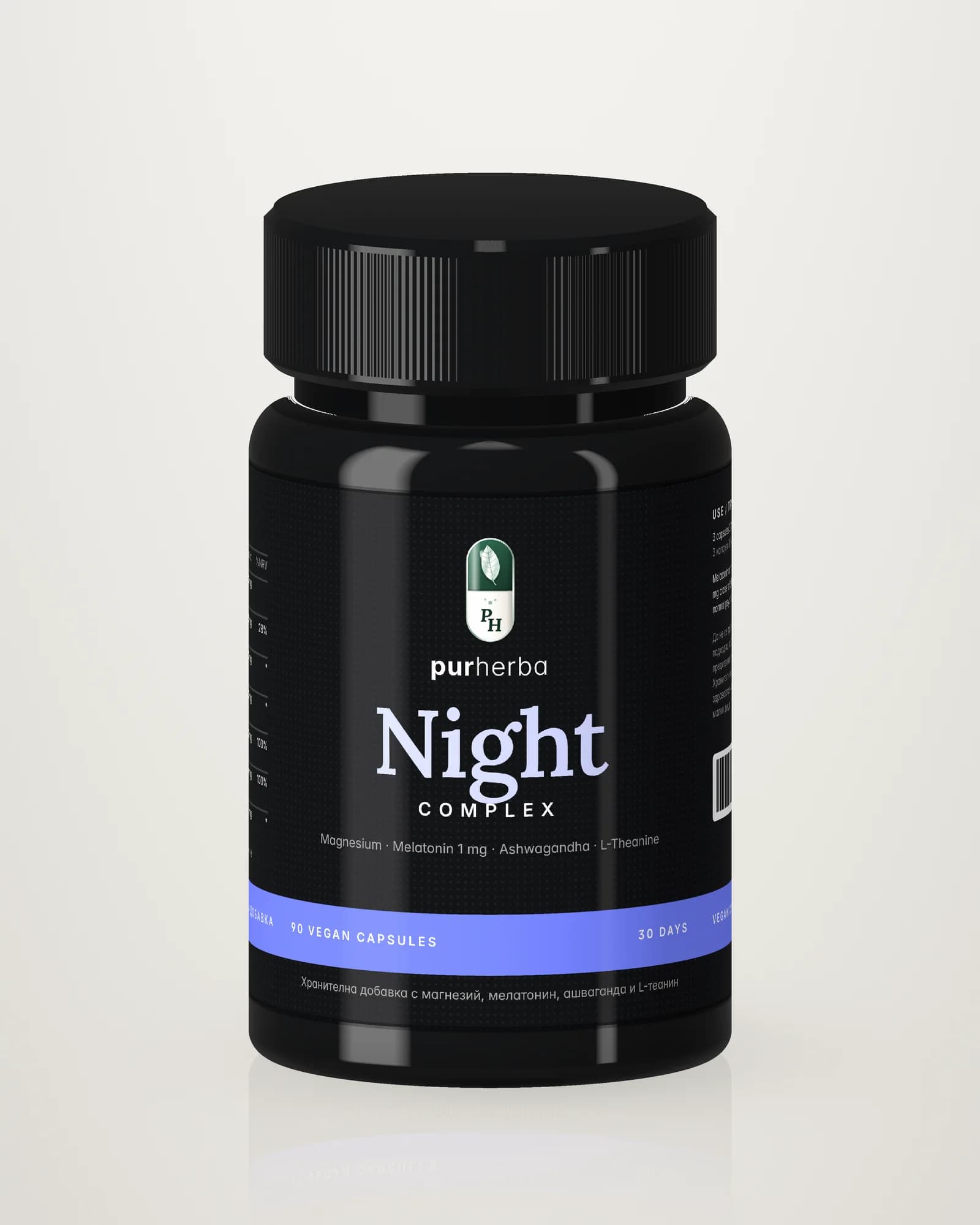
Ashwagandha in Night Complex
In Night Complex, ashwagandha is part of an evening formula: 300 mg of root extract (5% withanolides) together with magnesium bisglycinate, L-theanine, zinc, vitamin B6 in its active form and 1 mg of melatonin.
The EU-authorised claims for the formula come from the vitamins, minerals and melatonin in it: melatonin contributes to the reduction of time taken to fall asleep (the beneficial effect is obtained with 1 mg taken shortly before going to bed), while magnesium and vitamin B6 contribute to the reduction of tiredness and fatigue and to normal psychological function.
How to take it
3 capsules 30–60 minutes before bedtime, with water. The product is not suitable for pregnant or breastfeeding women or for anyone under 18. It may cause drowsiness — do not drive after taking it.
Sources
- 1.Mirjalili MH et al. (2009). Steroidal lactones from Withania somnifera, an ancient plant for novel medicine. Molecules 14(7):2373–2393
- 2.Thalhamer B et al. (2024). A feasible procedure to detect widespread wrong labeling of Ashwagandha root extracts in dietary supplements. Exploration of Foods and Foodomics 2:460–470
- 3.Ministry of Ayush, India. Advisory on the use of Ashwagandha roots only in Ayush products
- 4.Regulation (EU) No 432/2012 — list of permitted health claims
- 5.Photo: “Ashwagandha Roots”, Piyush Kothari, CC BY-SA 4.0, Wikimedia Commons