Berberine: how to choose it and what “≥ 97%” means
Which plant berberine comes from, why hydrochloride of ≥ 97% purity, what “1500 mg a day in 3 capsules” means, why silymarin, piperine and chromium sit beside it, and what the certificate of analysis must confirm.

Photo: Wikimedia Commons
Berberine is a yellow alkaloid from the roots of several plants that the traditional medicine of Asia and Europe has known for millennia. Today it is one of the most sought-after supplements, and one of the most uneven in quality. Here is what marks out a good product, and why.
How to choose
- Berberine hydrochloride (HCl) with a stated purity — ≥ 97% is the standard. Not “Berberis extract 10:1” with no number.
- The amount in milligrams of berberine per daily dose, not per capsule and not “extract”.
- A named plant and part: Berberis aristata root.
- A certificate of analysis for the batch: purity by HPLC, heavy metals, pesticides, microbiology.
- Clean ingredients: a vegetable capsule, no colourants and no unnecessary fillers.
Why these five? Read on.
The plant
Berberis aristata — Indian barberry, daruharidra in Sanskrit, “tree turmeric” — is a thorny shrub of the Himalayas, Nepal and Sri Lanka. Its root and bark are a deep yellow because of the berberine, and for centuries they have been used in Ayurveda and as a dye for wool and leather.
Berberine occurs in other plants too: in the European barberry (Berberis vulgaris), in Chinese goldthread (Coptis chinensis, huang lian in Chinese medicine), in Phellodendron and in North American goldenseal. The alkaloid was first isolated in 1830 from the bark of the European barberry, one of the first pure plant substances in the history of chemistry.
What berberine hydrochloride is
Berberine is an isoquinoline alkaloid with a positive charge; in pure form it is stabilised as a salt. The hydrochloride is the form used in almost all studies and in good supplements: a crystalline yellow powder with a clearly measurable purity.
This is the difference from “Berberis extract”: a 10:1 extract may contain 5%, 10% or 30% berberine, and the label rarely says which. With hydrochloride of ≥ 97% the sum is simple: 500 mg in a capsule is at least 485 mg of berberine.
Why 1500 mg in 3 capsules
The amount almost all published studies work with is 1500 mg a day, 500 mg before each main meal. The reason for splitting it is pharmacokinetic: berberine is poorly absorbed from the gut and cleared quickly, so one large dose gives less than three smaller ones.
That is why Berberine 1500 is 3 capsules, one before each main meal, rather than one “strong” capsule. The capsule is size 00: 500 mg of berberine plus its companions simply do not fit in a smaller one.
The companions: silymarin, piperine, chromium
- Milk thistle (Silybum marianum). Its seeds contain silymarin, a complex of flavonolignans (silybin, silychristin, silydianin) described by Dioscorides as early as the first century. Berberine 1500 contains 390 mg of extract standardised to 80% silymarin, that is 312 mg of silymarin. Silymarin appears alongside berberine in many formulas and in the scientific literature.
- Black pepper (Piper nigrum). Piperine is the pungent alkaloid of pepper. 5 mg of piperine, about as much as in a pinch of pepper, is the usual amount in supplements; we provide it as 5.3 mg of 95% extract. Piperine is also the reason for the warning on the label: it may affect the action of medicines.
- Chromium (picolinate), 100 µg — 250% of the reference value. Chromium is the only ingredient in the formula with EU-authorised claims: it contributes to the maintenance of normal blood glucose levels and to normal macronutrient metabolism. 100 µg is well below 250 µg a day, the ceiling for supplemental chromium recommended by the WHO and referred to by EFSA.
The certificate of analysis
A yellow colour is no proof of purity. The batch certificate of analysis should show berberine hydrochloride by HPLC (≥ 97%), loss on drying, heavy metals (lead, cadmium, arsenic, mercury), pesticide residues and microbiology. For the milk thistle extract, silymarin by HPLC (80%); for the pepper, piperine (95%).
The independent laboratory analysis of the finished product will be published on the product page with the first batch; the QR code on the pack leads to it.
What we say and what we do not
Berberine, silymarin and piperine have no authorised health claims in the EU, and we make none, whatever you may read elsewhere. The claims for Berberine 1500 come from the chromium.
In 2026 the European Food Safety Authority (EFSA) is assessing the safety of berberine in food supplements under the Article 8 procedure of Regulation 1925/2006. We are following the procedure and will bring the product into line with its outcome.
Berberine in Berberine 1500
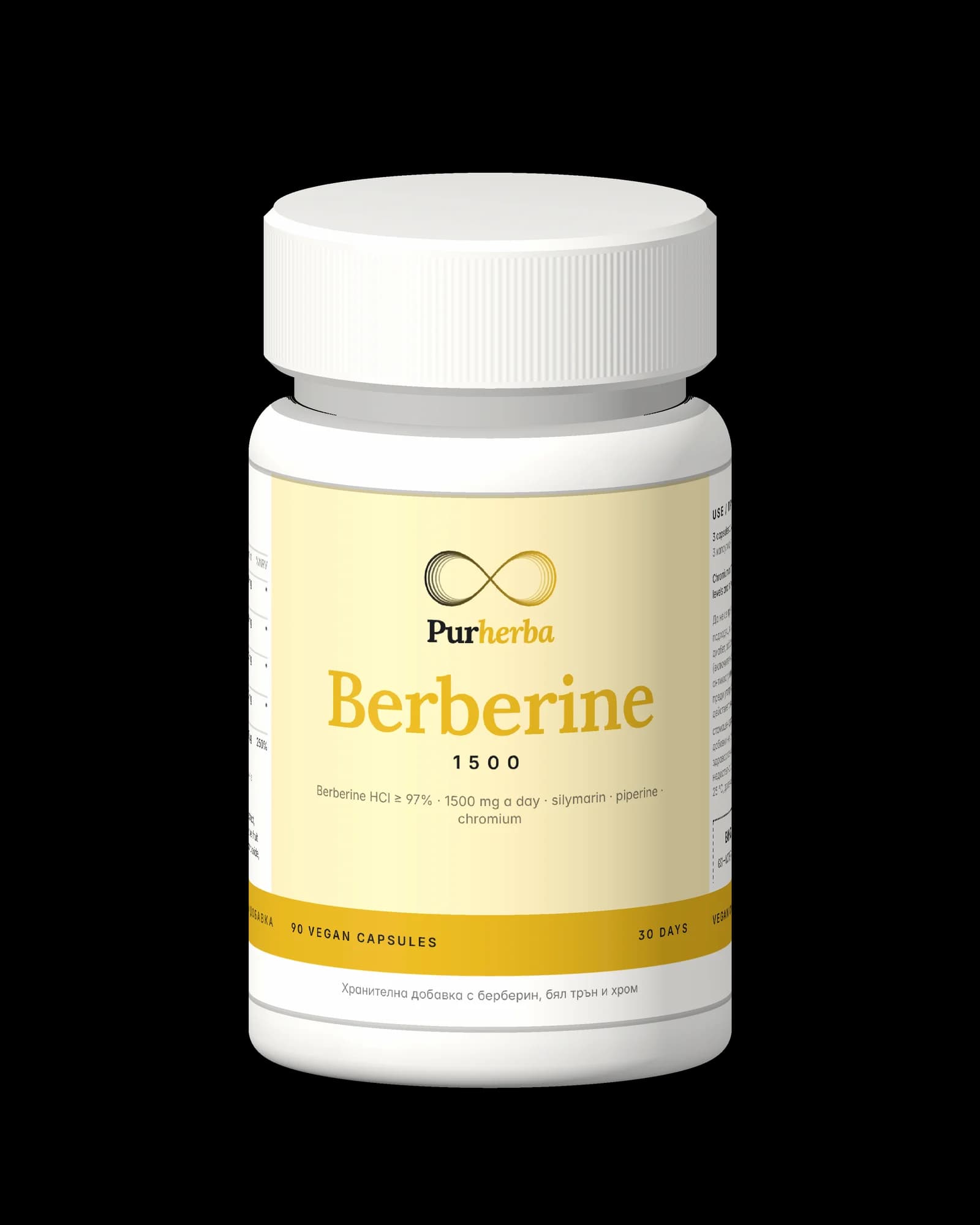
Berberine 1500: 90 vegan HPMC capsules, size 00, 30 days. Daily dose (3 capsules): 1500 mg of berberine hydrochloride ≥ 97% from Berberis aristata root, 390 mg of milk thistle extract (312 mg of silymarin), 5.3 mg of black pepper extract (5 mg of piperine), 100 µg of chromium. No colourants or fillers.
How to take it
3 capsules a day, 1 before each main meal, with water. Not suitable for pregnant or breastfeeding women or for anyone under 18. If you have diabetes or a liver condition, or take any medicines, consult your doctor: berberine and piperine may affect the action of medicines. Not a substitute for treatment. Do not exceed the recommended daily dose.
Sources
- 1.Neag MA et al. (2018). Berberine: botanical occurrence, traditional uses, extraction methods, and relevance in cardiovascular, metabolic, hepatic, and renal disorders. Frontiers in Pharmacology 9:557
- 2.Abenavoli L et al. (2018). Milk thistle (Silybum marianum): a concise overview on its chemistry, pharmacological, and nutraceutical uses. Phytotherapy Research 32(11):2202–2213
- 3.EFSA (2010). Scientific opinion on the safety of chromium picolinate as a source of chromium added for nutritional purposes. EFSA Journal 8(12):1883
- 4.Regulation (EU) No 432/2012 — list of permitted health claims
- 5.Regulation (EC) No 1925/2006, Article 8 — procedure for substances under scrutiny (EFSA botanicals)
- 6.Photo: “Fruiting Barberry (Berberis aristata) bush, Uttarakhand India”, Ramwik, CC BY-SA 3.0, Wikimedia Commons