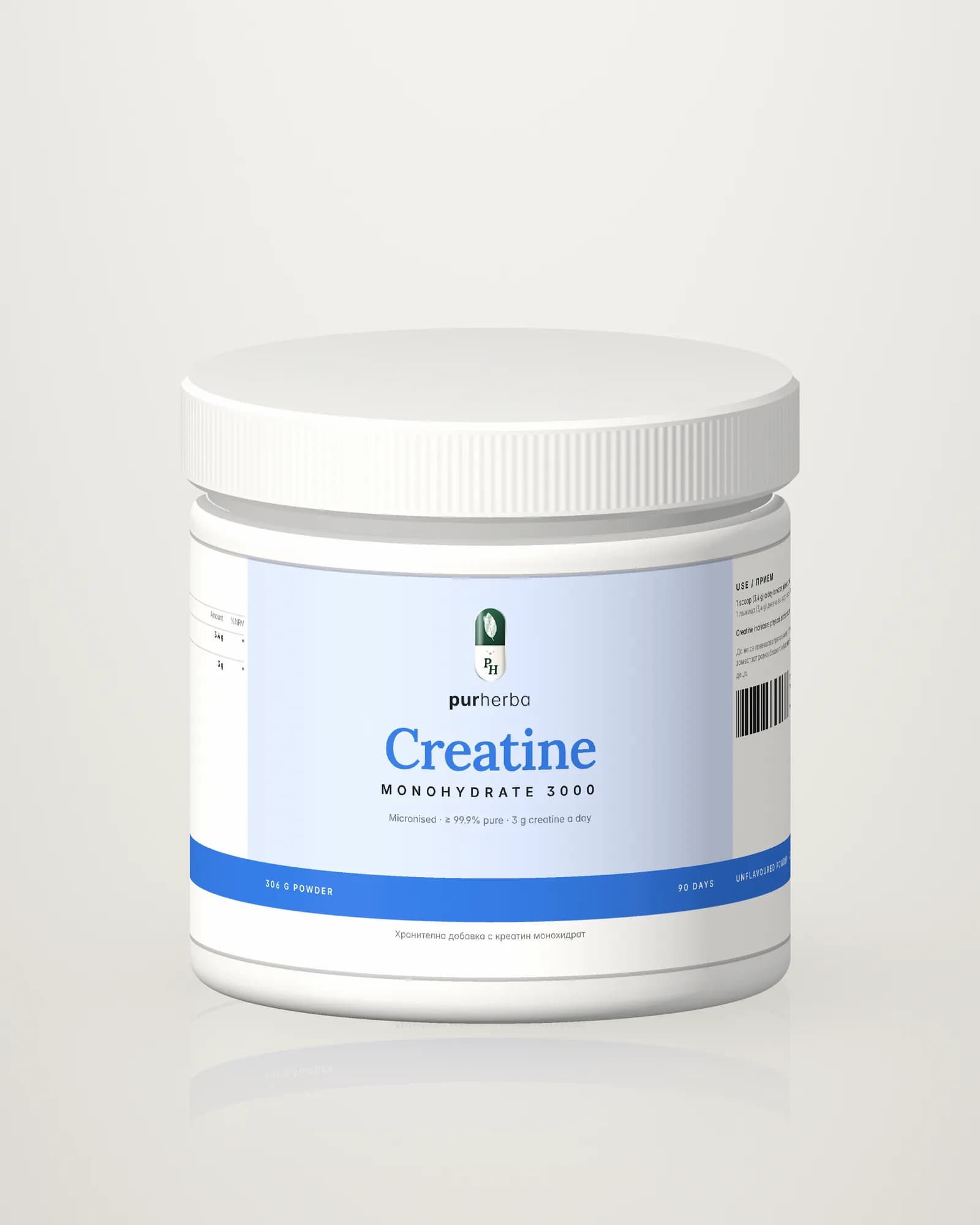
Creatine monohydrate: how to choose it and how to take it
Why monohydrate is the form the research was done with, what “3.4 g = 3 g of creatine” means, how to recognise pure creatine and how to take it every day.
October 11, 2026

Creatine is one of the most thoroughly researched supplements there is, and one of the simplest to choose once you know what to look for. Here is how, and why.
How to choose
- Creatine monohydrate: the form behind almost all of the science.
- Purity of at least 99.5%, confirmed by a certificate of analysis for the batch.
- A clear dose of creatine: 3 g a day is the amount at which the EU-authorised claims apply.
- Nothing extra: just creatine, with no sugar, flavourings or colourants.
- A fine (micronised) powder that stirs easily into water.
Why these five? Read on.
Why monohydrate
Creatine monohydrate is creatine bound to one molecule of water. It is the form used in hundreds of studies on creatine, and the form on which the authorised claims are based.
There are also “newer” forms on the market: buffered creatine, creatine ethyl ester, hydrochloride. When compared directly with monohydrate, they show no advantage: buffered creatine does not raise muscle creatine any further (Jagim et al., 2012), and the ethyl ester is even partly converted into creatinine before it reaches the muscles (Spillane et al., 2009). Monohydrate remains the gold standard, and it is usually the best value too.
Found in:Creatine Monohydrate 3000
What “3.4 g = 3 g of creatine” means
The water in monohydrate has weight too: creatine makes up about 88% of its mass. So 3.4 g of creatine monohydrate gives you 3 g of pure creatine, exactly the amount the authorised claims work with.
If a product says only “creatine 3000 mg”, check whether that refers to monohydrate or to pure creatine. The difference is about 12%.
Found in:Creatine Monohydrate 3000
Why purity matters
Creatine is made synthetically, from sarcosine and cyanamide. With good manufacturing the product is almost pure; with poor manufacturing, by-products remain in it: creatinine, dicyandiamide, dihydrotriazine. That is why a good certificate of analysis shows not only the percentage of creatine but also these impurities, plus heavy metals and microbiology.
The certificate for each of our batches is on the product page and behind the QR code on the product.
What creatine does
According to the EU-authorised health claims (Regulation 432/2012 and Regulation 2017/672):
- Creatine increases physical performance in successive bursts of short-term, high intensity exercise. The beneficial effect is obtained with a daily intake of 3 g of creatine.
- Daily creatine consumption can enhance the effect of resistance training on muscle strength in adults over the age of 55. The beneficial effect is obtained with a daily intake of 3 g of creatine in combination with resistance training, performed at least three times a week.
Where creatine comes from
Creatine was discovered in 1832 by the French chemist Michel Eugène Chevreul in an extract of meat; the name comes from the Greek kreas, “flesh”. The body also makes it, from the amino acids arginine, glycine and methionine, and the rest comes from meat and fish.
About 95% of the body’s creatine is in the skeletal muscles. Every day a small part of it is converted into creatinine and excreted, so the store is topped up daily, from food, from the body’s own synthesis or from a supplement.
How to take it
- 1 scoop (3.4 g) a day, stirred into water, juice or a shake, at any time of day.
- Regularity matters more than timing: creatine works when you take it every day.
- A “loading phase” (20 g a day for 5–7 days) is not necessary. With 3–5 g a day, the muscles reach the same level in about 3–4 weeks (Kreider et al., 2017).
- Drink plenty of fluids through the day.
One 306 g pack lasts 90 days.
Sources
- 1.Kreider RB et al. (2017). International Society of Sports Nutrition position stand: safety and efficacy of creatine supplementation in exercise, sport, and medicine. JISSN 14:18
- 2.Jagim AR et al. (2012). A buffered form of creatine does not promote greater changes in muscle creatine content, body composition, or training adaptations than creatine monohydrate. JISSN 9:43
- 3.Spillane M et al. (2009). The effects of creatine ethyl ester supplementation combined with heavy resistance training on body composition, muscle performance, and serum and muscle creatine levels. JISSN 6:6
- 4.Regulation (EU) No 432/2012 — list of permitted health claims
- 5.Commission Implementing Regulation (EU) 2017/672 — creatine and muscle strength in adults over 55
- 6.Photo: “Creatine monohydrate powder”, Awkwafaba, CC BY-SA 4.0, Wikimedia Commons